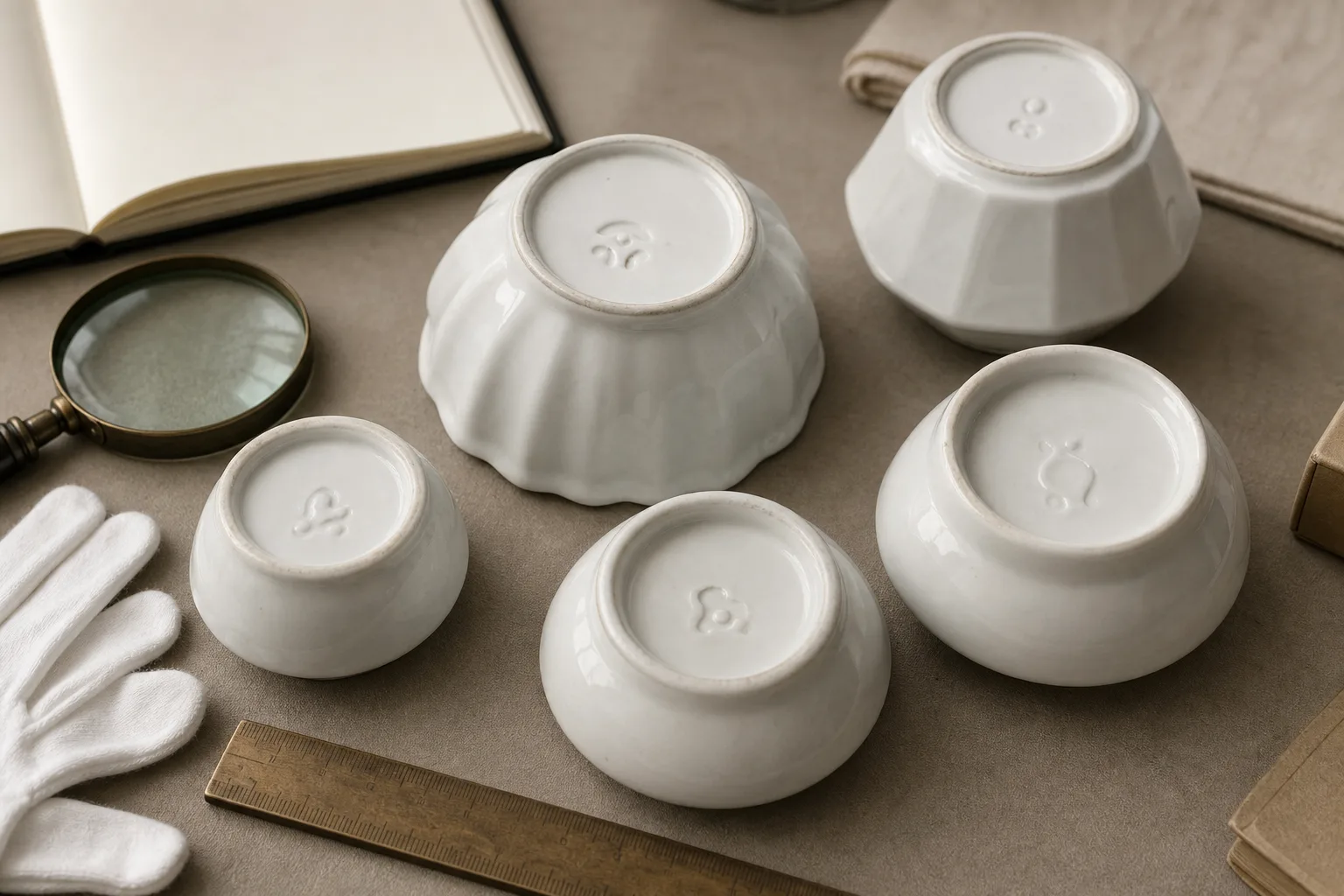
For Carlsbad Austria porcelain marks, start with the complete backstamp: does it actually include Victoria, and does the country line read Austria or Czecho-Slovakia? The Victoria references below distinguish those inscriptions and their documented variants. A piece bearing only Carlsbad cannot be assigned to Victoria from this comparison alone. The most useful result is a match to a particular reference, with any missing detail stated openly.
The Victoria variants to compare
The Old Stuff’s illustrated directory assigns these ranges to its pictured Victoria marks. Treat the dates as the directory’s attribution for the illustrated variant, rather than a date proved for every object with similar lettering. Follow the source photographs when comparing the complete design. Source (accessed 2026-09-19)
| Wording or variant in the directory | Reference range | Comparison to make |
|---|---|---|
| Victoria Carlsbad Austria | 1891–1918 | Confirm all the words; compare the actual arrangement with the pictured mark. |
| Round Victoria Austria | 1904–1918 | Check the circular layout rather than borrowing the Carlsbad range from another design. |
| Blue or green Victoria Austria variants | 1904–1918 | Match the wording and outline; color alone is insufficient. |
| Victoria Czecho-Slovakia | 1918–1939 | Use the later country wording as a different comparison, even if Victoria remains above it. |
These ranges overlap because the references describe different backstamps. Do not combine the beginning of one row with the end of another to create an apparently precise production period. If your photograph shows Victoria and Austria but the middle is unreadable, report those visible words and leave the precise variant unresolved.

Why Alt Rohlau and Stará Role appear in Victoria references
Museum and Gallery Most identifies the Victoria factory with Stará Role, also called Alt Rohlau, now a district of Karlovy Vary. Its collection record therefore helps connect the factory name to the locality used in reference descriptions. When researching a Victoria backstamp, include Alt Rohlau or Stará Role alongside the wording you can read, rather than rejecting an otherwise relevant museum record because its place name differs from Carlsbad. Source (accessed 2026-09-19)
Keep the visible inscription and the catalogue attribution in separate fields. For example, your transcription can say “Victoria … Austria,” while the attribution field says “possible Victoria factory; exact backstamp still to compare.” This preserves the evidence actually present on the object. It also prevents a search result containing the right town from silently becoming proof of the maker.
Green and blue impressions on a Victoria coffee service
Museum and Gallery Most describes a Victoria coffee service probably dating to 1918–1938. Some pieces bear green or blue underglaze marks, with Victoria above a decorated crown and Czecho-Slovakia below; a numeral may accompany the mark. The record describes transfer decoration combined with hand painting. Source (accessed 2026-09-19)
Read that documented arrangement as Victoria / crown / Czecho-Slovakia. Compare the order of the elements with your piece before considering decorative similarity. If your country line clearly says Austria, this museum example belongs in your comparison notes as a different inscription. If the country line is hidden by wear, the crown cannot supply the missing word. The description records an arrangement; it is not a drawing of every crown used by the factory.
The practical comparison is the relationship between lettering and crown, not merely the ink color or the presence of brushwork. Make a separate note for any accompanying numeral and leave its meaning unassigned unless a pattern or factory reference explains it. The cited museum description does not turn that numeral into a universal date code.
When comparing a cup with a saucer, transcribe each backstamp independently. Then state whether both inscriptions match the same reference, whether one is incomplete, or whether different country wording is visible. Avoid assigning the entire group the date of whichever mark happens to be clearest. This approach keeps a possible matched service distinct from a group whose relationship still needs checking.
Applying the references to an incomplete backstamp
Consider a hypothetical base with Victoria clearly visible, a crown in the middle, and an uncertain country line. The next useful photograph is a close view of that lower lettering. A floral decoration on the front does not resolve whether the underside reads Austria or Czecho-Slovakia. Compare the lower line first, then the crown outline and the placement of the other words.
For a hypothetical base reading Carlsbad Austria without a visible Victoria name, keep the attribution open. The table above documents Victoria variants; it does not establish that every Carlsbad-marked object came from that factory. Use our broader pottery hallmarks reference to investigate a different maker or an unidentified emblem instead of forcing this match.
A useful provisional catalogue note names the readable wording, identifies the exact comparison source, and states what remains uncertain. It might say “Victoria Austria; circular arrangement resembles the directory example; lower edge partly obscured.” That is more informative than “antique Carlsbad porcelain” because the next reviewer can test the proposed match.
After the mark has been narrowed down
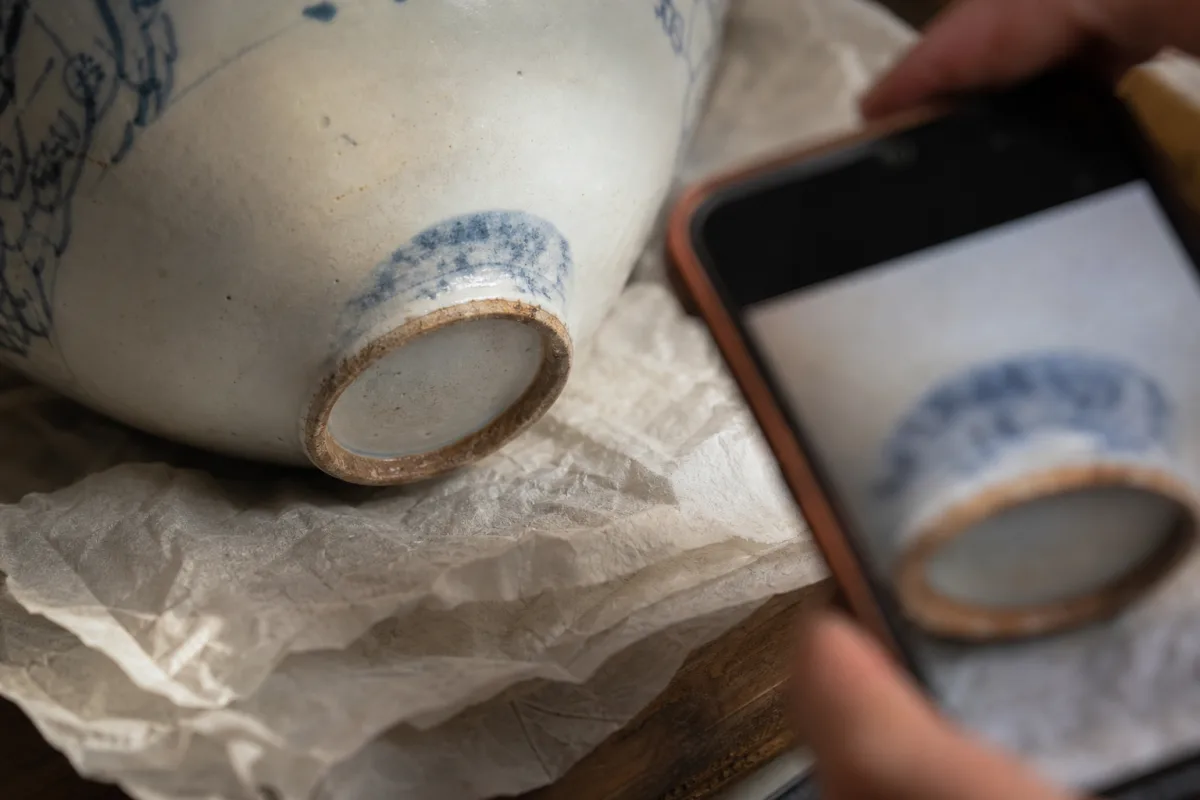
Keep the source image or collection record beside your own base photograph when requesting an opinion. Ask the specialist to assess the proposed Victoria variant, the country wording, and whether the object is consistent with that attribution. If the backstamp remains incomplete, request an identification opinion before a firm valuation.
For the separate question of condition and sale comparisons, use our antiques and collectibles appraisal guide. If you need someone to review an uncertain attribution, compare the options in online antique appraisal services. A documented backstamp comparison gives that review a concrete starting point; it does not by itself authenticate an object or establish its price.