
Pottery hallmarks can point toward a factory, studio potter, decorator, pattern, retailer, or production period, but they rarely identify a piece on their own. Start by recording the mark exactly as it appears, then test it against the vessel’s form, clay, glaze, decoration, construction, and history of ownership. Historical pottery reference works distinguish factory, workman, and pattern marks; that distinction is useful because not every mark names the maker. Source: museum.wa.gov.au, accessed 2026-08-07
What counts as a pottery hallmark?
Collectors often use “pottery hallmark” as a catch-all phrase for a mark found on ceramics. In practice, identify the type before trying to identify the name. A factory mark may represent the pottery that produced the object. A potter’s signature may identify an individual maker. A workman mark can relate to a person involved in production, while a pattern mark may identify a design rather than a manufacturer. Source: museum.wa.gov.au, accessed 2026-08-07
- Impressed marks are pressed into soft clay and may be easiest to read under raking light.
- Incised marks are scratched or cut into the surface.
- Painted marks are applied by hand and may vary slightly between examples.
- Printed marks are transferred or stamped onto the finished ware.
- Paper labels, stickers, and handwritten inventory notes are useful leads, but should be recorded separately from marks fired into or applied to the ceramic.
A mark that looks like a name is not automatically a maker’s signature. It could be a decorator, retailer, importer, pattern name, or later owner notation. Treat each possibility as a working hypothesis until the object and a reliable reference agree.
Find and capture the mark before searching
Look first on the underside of a base, foot ring, rim, lid, handle junction, or inside a vessel. Check every detachable component. Photograph the full object as well as the mark: an isolated base image can hide clues supplied by the shape, decoration, and scale.
- Take a straight-on image of the mark and another in angled side light.
- Photograph the entire base, including the foot ring and unglazed clay.
- Make a careful transcription of every letter, numeral, punctuation mark, monogram, and symbol.
- Note uncertain characters with alternatives, such as “I or J” or “O or Q,” rather than silently guessing.
- Record dimensions, weight if available, visible repairs, chips, crazing, and any ownership history.
Do not rub, scrape, chalk, or chemically clean a faint mark merely to make it readable. Better light, a close image, and a second photograph at a different angle preserve evidence without risking the surface.
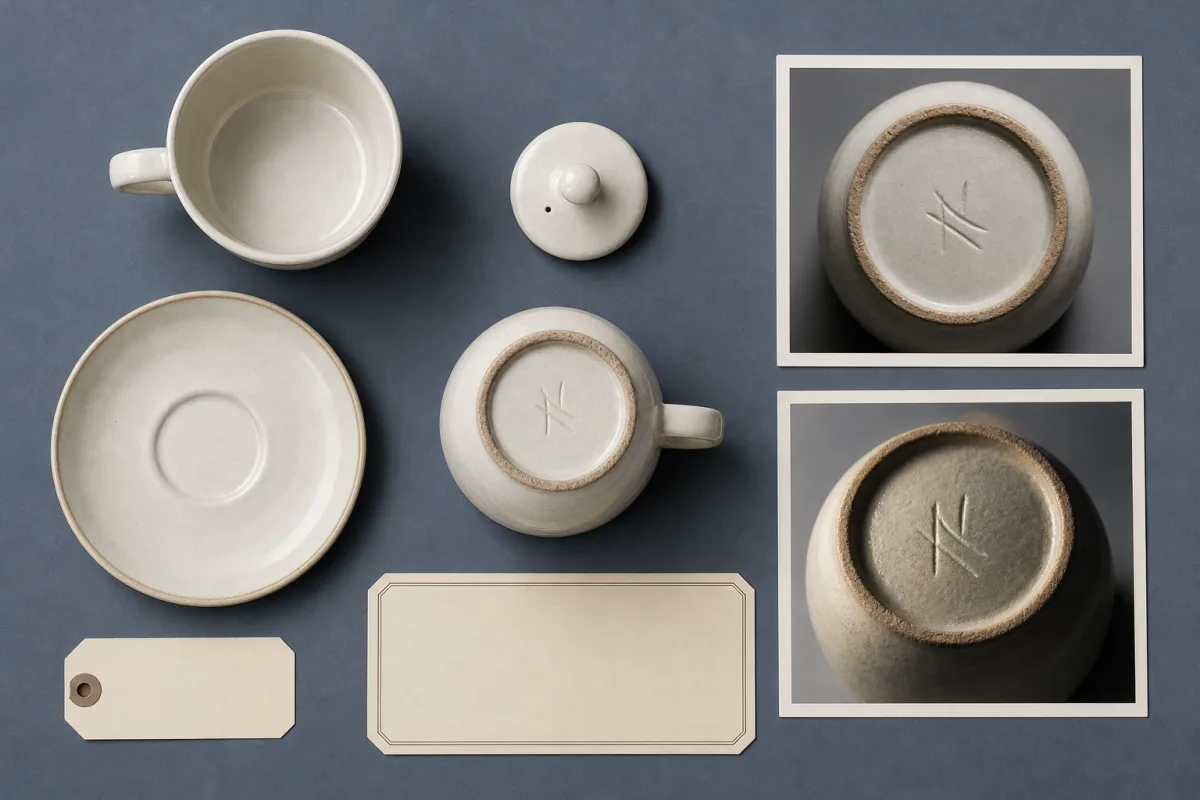
A practical identification sequence
-
Describe the object before naming it. Is it earthenware, stoneware, porcelain, or an uncertain ceramic body? Record form, glaze, decoration, and construction details.
-
Classify the mark. Decide whether it appears impressed, incised, painted, printed, labeled, or combined with another mark.
-
Search the most distinctive element first. A full surname is more useful than a generic crown, shield, star, or initials. For a partly legible studio signature, use only the letter sequence you can actually see. The Marks Project’s mark search asks users to enter at least three consecutive letters of a signature. Source: themarksproject.org, accessed 2026-08-07
-
Compare candidates against the physical object. Ask whether the candidate maker is associated with this form, material, glaze treatment, and decoration. A visual resemblance in a marks chart is not enough.
-
Seek an independent confirmation. Compare a specialist database entry with a museum, library, exhibition catalogue, auction record, or regional reference.
-
Record a confidence level. “Possible,” “probable,” and “confirmed” are more useful than presenting an early match as certain.
Read symbols, numbers, and wording in context
Initials and symbols are especially prone to false matches because unrelated makers can use similar devices. Search by the visible features of the mark, then narrow the candidates with place, material, and period clues. A number may be a pattern, shape, decorator, mold, stock, or registration-related reference; do not assume it is a date.
Country wording can be a helpful clue, but it should be interpreted alongside the entire backstamp and the object itself. Likewise, a manufacturer may use changing versions of a device over time, so an exact match matters more than a broad resemblance. For North Staffordshire wares, the Potteries site organizes marks used on pottery associated with Stoke-on-Trent and is a useful regional starting point. Source: thepotteries.org, accessed 2026-08-07
Choose a resource that fits the object
There is no single reliable database for every pottery hallmark. Use a resource whose scope matches the likely place and type of production, then verify the result elsewhere.
-
For American studio and contemporary ceramics, The Marks Project focuses on marks and works by ceramic artists. Source: themarksproject.org, accessed 2026-08-07
-
For British and Irish studio pottery, the British and Irish Studio Pottery Marks site offers a dedicated mark search and includes filters for features such as impressed and incised marks. Source: bispm.co.uk, accessed 2026-08-07
-
For Staffordshire and other English industrial pottery, begin with a regional marks index, then compare the ware and decoration with documented examples. Source: thepotteries.org, accessed 2026-08-07
-
For a broader studio-pottery search across several countries, use a marks lexicon as a candidate generator, not as final proof. Source: robertzueblin.com, accessed 2026-08-07
-
For porcelain, glass, ceramics, and research methods, a library identification guide can help locate reference tools beyond a simple image match. Source: guides.library.unt.edu, accessed 2026-08-07
Image search can be useful for finding related examples, but use it as a discovery tool. Compare the full mark, not just the central emblem, and look for documented object details that match your piece.
Date and authenticate with more than the backstamp
A mark can help establish a possible date range when an exact version is documented, but materials and making methods may support or challenge that range. Examine the clay body, foot ring, glaze pooling, mold seams, hand finishing, decoration technique, label style, and wear. Provenance can also matter when it is specific and traceable.
Be cautious with marks that are unusually crisp on an object that otherwise appears heavily worn, marks positioned awkwardly across a curved surface, or a familiar device paired with lettering that does not match known examples. These observations do not prove a reproduction or forgery; they mean the attribution needs stronger comparison. Transfer marks, later retailer labels, restoration, and shared motifs can all complicate a first reading.
Questions to ask when two candidates look similar
- Does either candidate use the same complete lettering and symbol arrangement?
- Does the object’s clay, form, and decoration fit the candidate?
- Is the candidate documented for the likely region?
- Is there a dated reference example with the same mark version?
- What evidence contradicts the preferred attribution?
A maker identification is not a value appraisal
A recognizable mark does not by itself establish market value. Value depends on the maker or factory, scarcity, condition, form, decoration, provenance, current demand, and relevant sold comparables. An ordinary form by a known maker may sell differently from a scarce form with excellent condition, and a damaged object may be less desirable even when the mark is authentic.
For a value question, identify the object as accurately as possible before comparing genuinely similar sold examples. Our antiques and collectibles value guide explains the evidence to gather before making a value estimate, and online antique appraisal sites compared can help you decide what type of outside opinion you need.
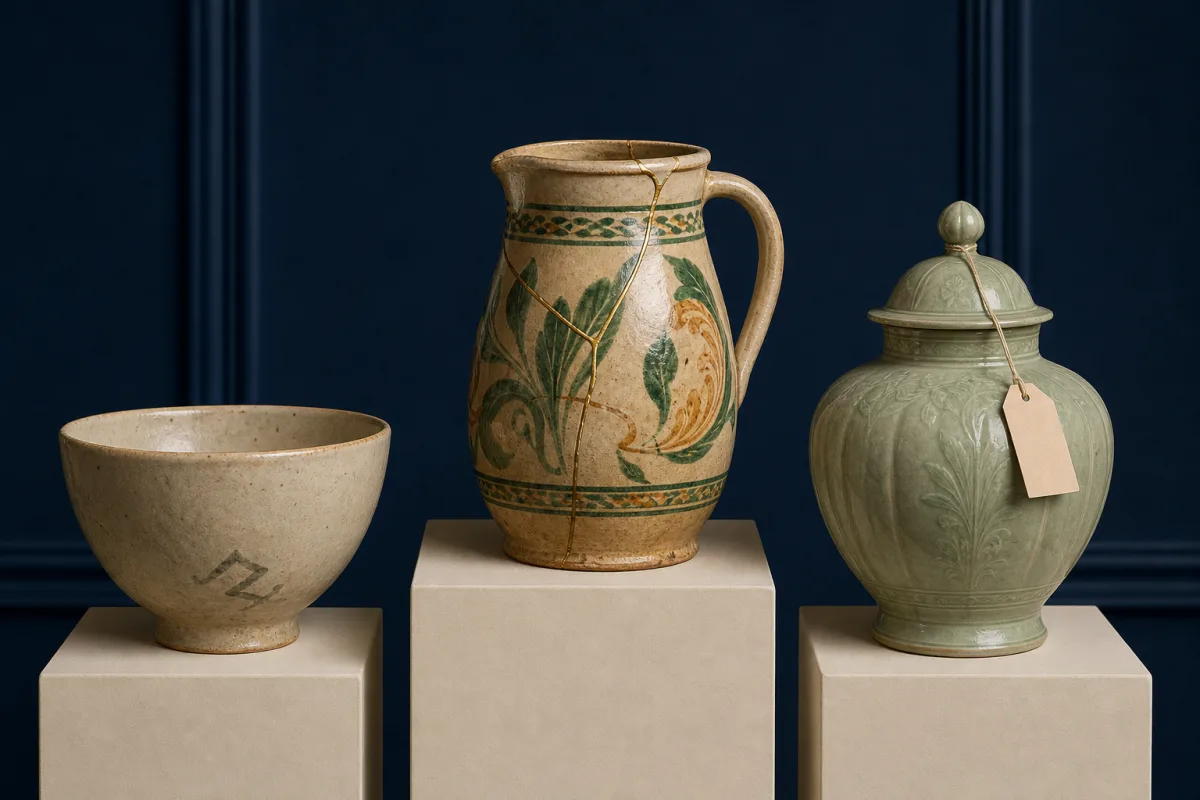
When expert help is the sensible next step
Consult a regional pottery specialist, auction-house specialist, museum curator, or qualified appraiser when the piece may be important, the mark is ambiguous, authenticity affects the decision, or condition and restoration need close inspection. Send full-object images, close views of the mark and base, measurements, damage images, and a short account of provenance. A clear evidence packet gives an expert more to work with than a cropped mark alone.
If your item may be porcelain rather than pottery, the distinctions in this German porcelain marks identification article are also useful practice for reading small molded and painted marks. For a broader appraisal workflow, see antique appraisal services.