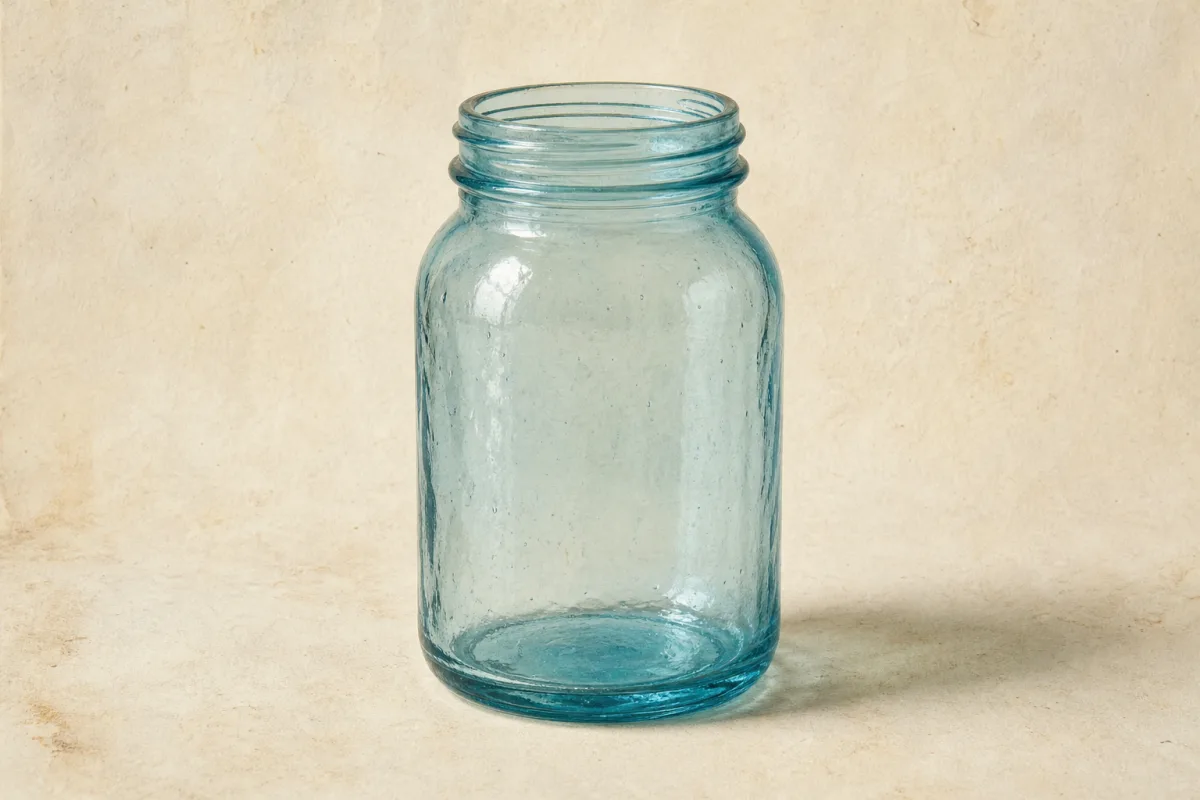
Most vintage Ball Perfect Mason jars are collectible rather than automatically rare. Their value usually turns on the exact embossing and mold variation, glass color, size, closure pieces, condition, and evidence from comparable completed sales—not simply on the words “Ball Perfect Mason.” A well-photographed, intact jar can be easier to assess than a supposedly scarce one with an uncertain history.
Start with the glass, not the asking price
Put the jar on a plain, light background and examine it empty. Read the front embossing exactly as it appears, then photograph the base, neck, shoulder, and mouth. “Perfect Mason” is part of a widely collected Ball jar family, but it is not a standalone guarantee of age or high value. Dating references use the wording, logo treatment, and placement of marks together rather than treating one word as a complete answer. Source (accessed 2026-11-19)
One commonly circulated dating reference places a Ball jar with “perfect” on the bottom in an approximate production window of 1913–1922. Treat that as a starting point for comparison, not a date stamped on every jar with related wording. Molds, logos, and stock could overlap, and a jar should not be dated from color alone. Source (accessed 2026-11-19)
Read a Ball Perfect Mason jar in a sensible order
- Transcribe the front. Note the lettering style, the placement of “BALL,” “PERFECT,” and “MASON,” and every visible punctuation mark or unusual letter shape.
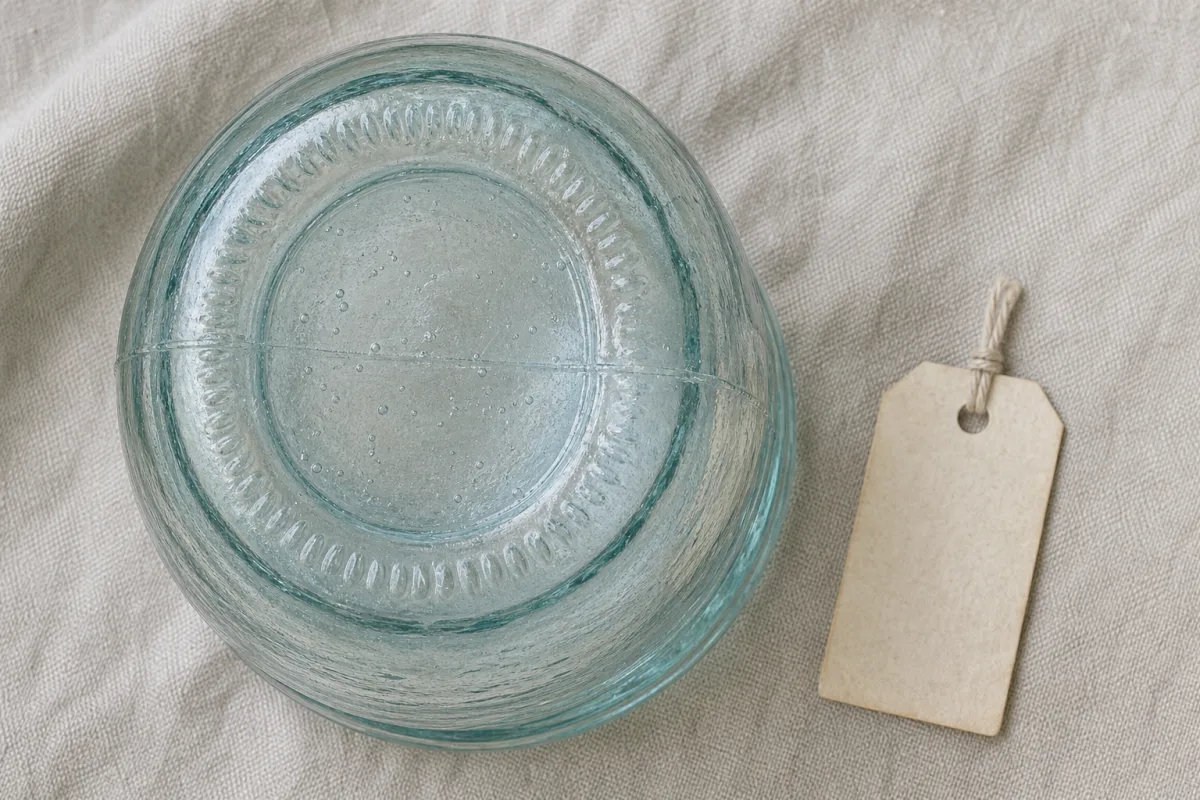
- Photograph the base separately. Record mold numbers, letters, dots, seams, and any “Perfect” wording. A base number identifies a mold or production detail; it does not, by itself, prove scarcity.
- Check the finish and mouth. Identify whether the jar takes a regular or wide closure and whether its rim is smooth, chipped, ground, or visibly altered.
- Measure the capacity and shape. A squat jelly form, a common household canning form, and an unusually large or small format can attract different buyers. Describe what you can measure rather than guessing the capacity from a photograph.
- Separate jar from accessories. Photograph the lid, glass insert, zinc cap, wire bail, and band individually. They may be later replacements even when they fit.
A later Ball product page shows that the company continues to market color-series Mason jars. That matters when identifying a colored jar: color alone is not proof that a piece is old. Source (accessed 2026-11-19)
What makes one jar more interesting than another
For ordinary examples, collector interest is often modest when the jar is aqua, widely encountered, and missing its correct closure. Interest can rise when a jar has an unusual color, a less often seen form or size, a documented mold variation, unusually crisp embossing, or a complete period-appropriate closure. None of those clues works in isolation. An unusual color with a chipped rim can be less desirable than a common color in exceptional condition.
| Feature to compare | What to record | Why it changes the appraisal |
|---|---|---|
| Embossing | Exact words, lettering style, location, punctuation | It is the best starting point for matching a reference or completed sale. |
| Color | Aqua, clear, amber, cobalt, or another observed shade; photograph in daylight | Color can affect demand, but lighting and modern colored jars can mislead. |
| Mold details | Base marks, seam placement, bubbles, wrinkles, and mold-made irregularities | These help distinguish production variation from later damage. |
| Closure | Every component, its fit, wear, and markings | A matching, sound closure can improve completeness and buyer confidence. |
| Condition | Rim chips, cracks, haze, stains, scratches, rust transfer, and repairs | Structural damage normally matters more than decorative appeal. |
| Provenance | Old collection labels, family records, or a documented purchase history | Useful documentation can support an identification; an unsupported story cannot. |
Condition is where casual valuations go wrong
Hold the empty jar to a bright window or diffuse lamp. Rotate it slowly and feel only gently around the rim. A hairline crack may vanish against a busy background; cloudy film can look like age but may be residue, mineral deposit, or irreversible glass sickness. Describe the issue before trying to correct it.
Manufacturing character can be appealing: tiny seed bubbles, stretch marks, and mild asymmetry may belong to the original glass. A fresh chip, a sharp star crack, glued break, drilled hole, painted surface, or artificially aged-looking stain is different. Say which you see and show it in a close image. For a wider framework on how age interacts with desirability and condition, see Vintage vs Antique Value: How Age Changes the Price.
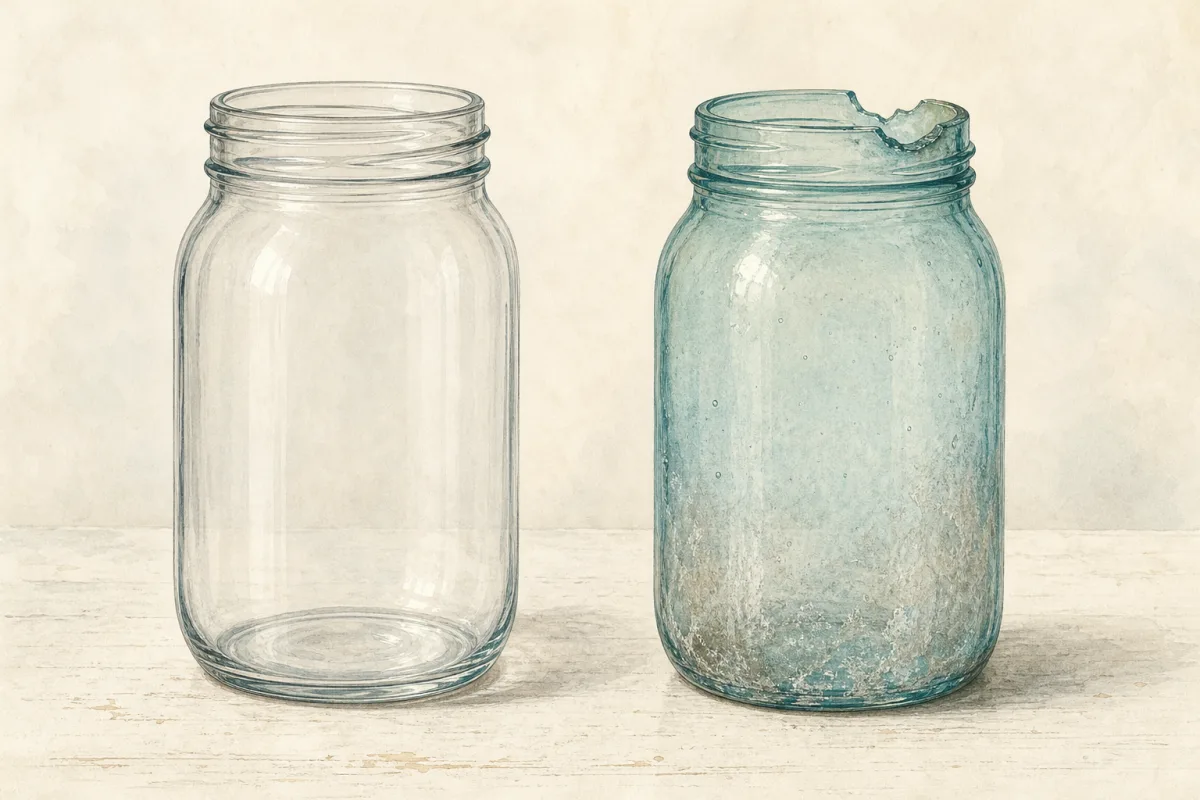
Two illustrations that help document a jar honestly
Good identification photographs should make the viewer less dependent on a seller’s description. Avoid filters, dramatic backlighting, and props that hide the rim or base.
Turn listings into useful comparables
Online listing prices are requests, not proof of a sale. Build a short comparison set from jars that actually match your example in embossing, color, size, condition, and closure completeness. Then give more weight to completed transactions than to unsold advertisements. If a listing calls a jar “rare,” look for the photographed mark and compare it with reference material before accepting the label.
Keep notes in two columns: what is directly visible and what the seller claims. “Aqua glass, crisp front embossing, small rim chip, replacement band” belongs in the first column. “Rare” belongs in the second until verified. This approach also makes it easier to explain why two superficially similar jars may not justify the same estimate. If you plan to sell online, the eBay Fee Calculator can help separate a sale price from likely selling costs.
Mistakes that can cost a Ball jar owner money
- Dating by color alone. This can turn a modern decorative jar or a common aqua jar into an overstated antique claim. Check embossing, mouth, base, and form together.
- Polishing or soaking before recording the condition. Aggressive cleaning can scratch glass, disturb original surface character, or conceal the evidence an appraiser needs to see.
- Calling every base number a rarity mark. A number is often a mold identifier. Treat it as a comparison clue, not a value conclusion.
- Using a high active listing as the value. This risks setting an expectation no buyer has accepted. Compare genuinely similar completed transactions instead.
Practical steps before you ask for a valuation
- Take a straight-on front photograph. It preserves lettering proportions and makes embossing comparisons more reliable.
- Use side lighting for the rim and base. Low, raking light reveals chips, cracks, and shallow marks that front lighting can hide.
- Photograph every closure part separately. This prevents a matching lid from being assumed when it is actually a replacement.
- Use dry, soft handling. Support the base and body rather than lifting an old jar by a wire or lid, which can stress both glass and hardware.
- Leave stubborn residue alone until it is identified. A conservator or jar specialist can advise when cleaning may affect value or safety.
When a closer appraisal is worth arranging
Seek an antiques specialist when the color seems genuinely unusual, the embossing does not match accessible references, a collection has strong documentation, or a buyer has offered a significant amount. A specialist can inspect mold features, glass condition, alterations, and closure compatibility in person. For a broader view of online and professional options, read Best Online Antique Appraisal Sites Compared and Antiques and Collectibles Value Guide for Real-World Appraisals.
If this were my jar, I would slow the process down
I would first photograph the jar untouched: front, back, both sides, base, rim, and every closure component. Next I would write down only what is visible, match the embossing and form to dated references, and identify condition issues under plain light. After that, I would compare completed sales for genuinely similar examples and keep the result as a range of possibilities rather than a promise.
I would leave deep cleaning, replacement parts, dramatic “rare” language, and a firm sale price for later. Those steps are easy to reverse badly and hard to defend once a knowledgeable buyer asks for close photographs.
Questions owners often ask
Are old Ball Perfect Mason jars worth anything?
Some are, but age and the name alone do not establish a high value. Exact variation, color, condition, closure completeness, provenance, and comparable completed sales matter together.
Does an original lid increase value?
A sound, period-appropriate closure can make a jar more complete and easier to identify. It should be assessed as a component, not assumed original merely because it fits.
Should I clean a vintage jar before selling it?
Use only careful dry dusting until you have documented the condition. Avoid abrasives, harsh chemicals, and methods that can scratch glass or alter the surface.
Why does my jar have a number on the base?
Base numbers are useful production clues, often associated with a mold. They should be photographed and compared with the rest of the jar rather than treated as proof of rarity on their own.