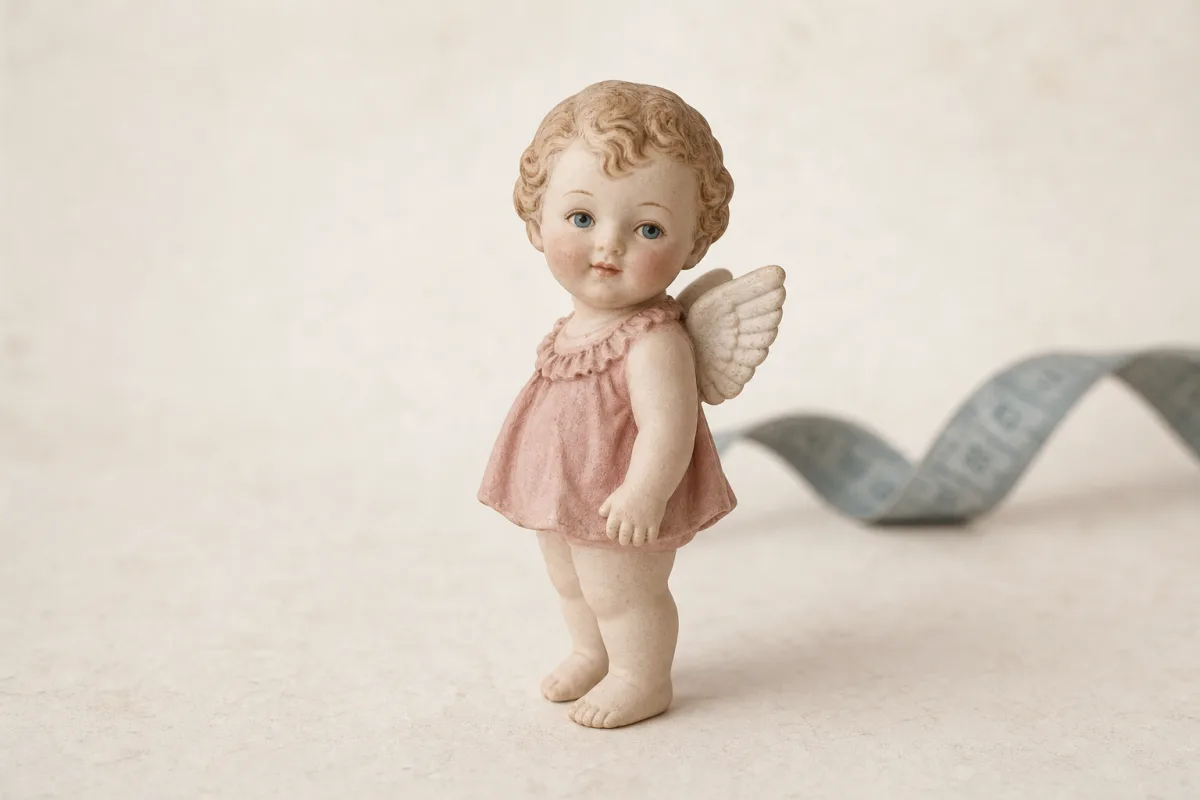
A vintage Cupie doll is usually a Kewpie doll described with a common alternate spelling. Start with the material, construction, any markings, the wings, and condition before assigning an age or value. The most sought-after examples are not simply the oldest-looking: a small, clearly marked doll with original paint and an unusual form can be more compelling than a larger damaged one.
A quick first read of your doll
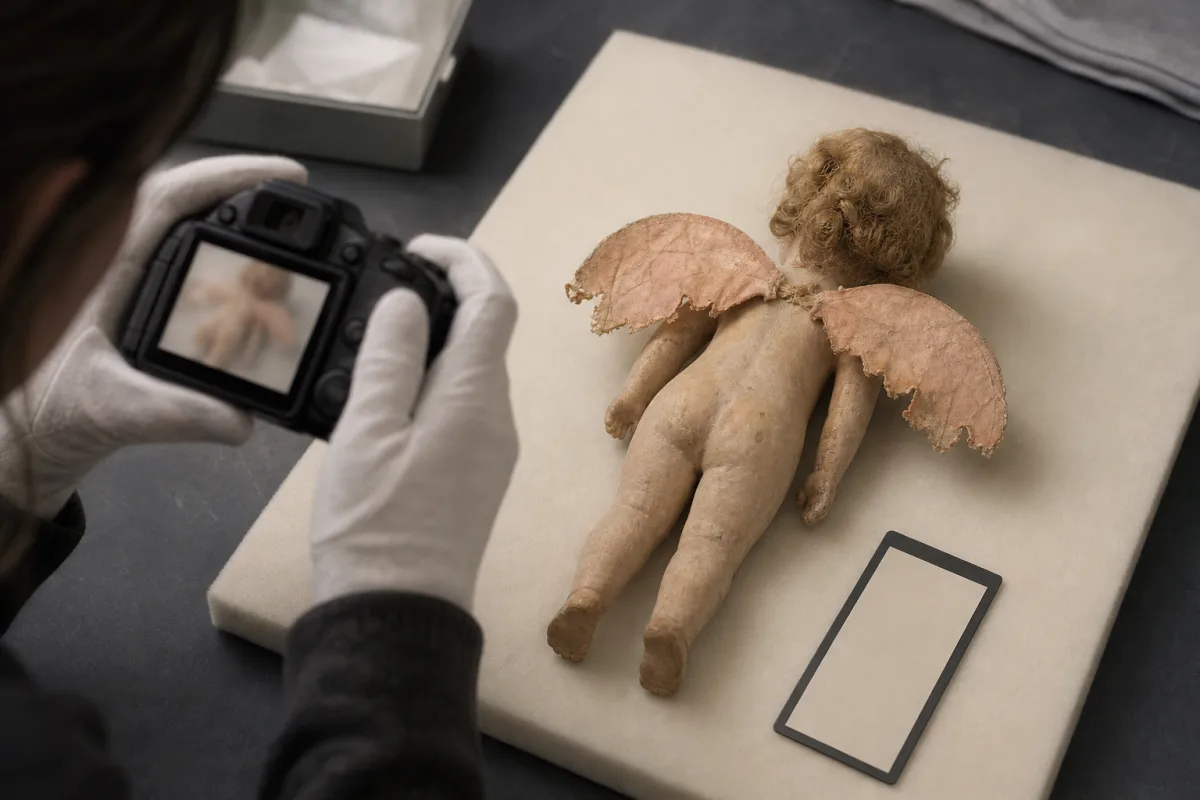
Handle the doll over a folded towel and avoid cleaning it before you document it. Take clear photographs of the face, both wings, the back, feet, joints, clothing, and every mark. Then record the height, whether the limbs move, and whether the body feels hard and ceramic-like, dense and painted, or thin and lightweight.
- Hard, matte ceramic surface: it may be bisque. Look especially closely for chips at the wing tips, fingers, toes, and neck.
- Painted, pressed-pulp-like body: it may be composition. Check for cracking, lifting paint, swelling, or restoration.
- Very light, thin body: it may be celluloid or another later plastic. Do not use heat, solvents, or strong pressure while examining it.
- Clear country or maker mark: photograph it rather than relying on memory. A mark is evidence to research, not an automatic date or guarantee of originality.
If the doll is porcelain or bisque, compare its wording, placement, and molding with the methods in our German porcelain doll marks identification guide. A close, well-lit mark photograph is often more useful than a full-body image.
Cupie, Kewpie, and Rose O’Neill
Collectors generally use Kewpie for the wide family of winged baby figures associated with illustrator Rose O’Neill; “Cupie” is a frequent spelling in searches and listings. The character history matters because many later souvenirs and decorative figures borrow the familiar winged-baby look without being early Kewpie dolls. Source (accessed 2026-11-06)
Kewpie dolls were first manufactured in 1912. Early examples are commonly associated with bisque, while composition versions arrived later and celluloid versions also appeared; material therefore provides a useful starting point, but it cannot date every individual doll by itself. Source (accessed 2026-11-06) Source (accessed 2026-11-06)
Read material and construction together
Do not date a doll from the face alone. Kewpie-style faces can have a rounded forehead, wide eyes, pursed or smiling mouth, and small wings, but these traits were repeated for decades. Instead, build an identification from several observations.
| Observation | What to investigate | Why it matters |
|---|---|---|
| Bisque body | Mold quality, original paint, country mark, damage around extremities | Early material does not by itself prove a maker or an exact date. |
| Composition body | Seams, paint condition, cracking, and joint construction | Surface condition can materially affect collectibility. |
| Celluloid body | Thinness, molded seams, distortion, and safe storage history | Lightweight construction distinguishes it from bisque and composition. |
| Jointed or frozen-leg pose | Whether the movement and hardware appear original to the molding | Construction may help separate doll types, but it should be compared with documented examples. |
“Frozen leg” usually describes a fixed leg pose rather than a leg that has become stuck. “Jointed” means a limb was designed to move. “Marked” means the object bears identifying text, symbols, or numbers; it does not mean the attribution has been verified.
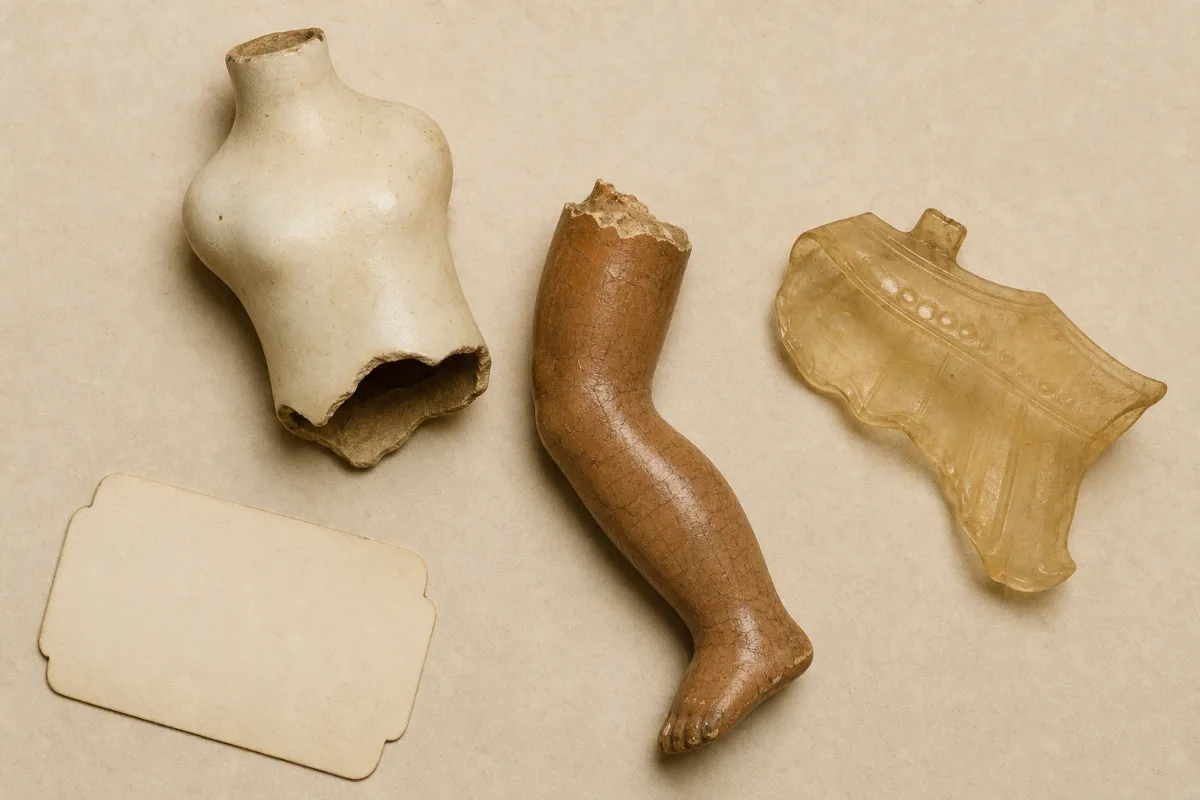
Germany, Japan, and later look-alikes
Country wording can be an important lead. Dolls described as German or Japanese should be evaluated from the actual mark, material, manufacturing method, and the entire object—not from a seller’s title. A missing mark also has several possible explanations: it may have been worn away, hidden by clothing, omitted, or never present.
Separate the following categories before researching prices:
- Antique or vintage Kewpie doll: an older object whose material, construction, and marks support its period.
- Reproduction: a later object made to resemble an earlier Kewpie style.
- Souvenir or carnival-type figure: a related decorative object that may not have the same construction or collector market as an early doll.
- Modern decorative doll: an object using the visual motif without evidence of early manufacture.
Fresh-looking paint on a heavily worn body, unusually sharp molded lettering, mismatched limbs, newly attached wings, or clothing that conceals damage are reasons to slow down. They are not proof of deception. Ask for images of concealed areas and compare all visible wear: age-related wear normally should not appear only where it is convenient for a listing.
What drives a vintage Cupie doll’s value
Value is an outcome of identification and market evidence, not a property of the word “vintage.” Begin with material and likely period, then weigh maker or country marks, size, rarity of pose or costume, completeness, original finish, and condition. Original accessories or clothing can matter, but only when they can be reasonably associated with the doll.
Condition is often decisive. Chips, hairlines, repaired breaks, repainting, missing wings, fading, odor, cracked composition, and replaced clothing should be disclosed and photographed. A restoration may make a doll more presentable, yet it can reduce interest for collectors seeking original surfaces. For context on the difference between age labels and market value, see vintage versus antique value.
Use completed-sale records when available, matching the material, size, condition, and completeness as closely as possible. Asking prices are not sale prices. One published Kewpie price guide gives an estimated value of $300 to $400 for a cited example, illustrating why a single broad range should never be applied to every Cupie doll. Source (accessed 2026-11-06)
A practical appraisal record
- Photograph the doll front and back in diffuse daylight, plus close views of the face, wings, feet, joints, damage, and marks.
- Measure height without stretching or forcing movable parts.
- Write a condition note that distinguishes original wear from visible repairs and missing components.
- Research the exact mark and construction before searching broad phrases such as “rare Cupie.”
- Compare completed sales only after you have separated early dolls from reproductions and decorative figures.
- Keep the image set, measurements, provenance, and comparable records together for insurance, sale, or a specialist review.
If photographs leave key questions unresolved, a structured identification record can make the next step more efficient. The Antique Value Identifier (Idar) app is presented as an antique identification and appraisal product. Source (accessed 2026-11-06) For a higher-stakes sale or insurance schedule, obtain an appraisal appropriate to the purpose rather than treating an online estimate as a formal valuation. You may also find our online antique appraisal sites comparison useful when deciding what level of review you need.
Storage and selling notes
Store a doll away from direct sunlight, damp conditions, extremes of heat, and pressure on fragile wings or extremities. Avoid adhesive labels directly on the object. When selling, show flaws rather than cropping them out, state what is known versus assumed, and include photographs of all marks. Clear disclosure protects both the buyer and the credibility of your attribution.
Collector terms at a glance
Bisque is unglazed ceramic with a matte surface. Composition refers to a molded composite material often finished with paint. Celluloid is an early lightweight plastic. Frozen leg describes a fixed leg pose. Jointed describes limbs designed to move. Marked means a doll bears an identifying mark that still needs interpretation.
A good conclusion may be “Kewpie-style doll, material and origin still unconfirmed.” That is more useful—and more honest—than assigning an exact age or premium value from a single photograph.